
Hopi experiences
Hopi people and ceremonies

05162025
In 1913 my grandfather moved his family to the remote Navajo reservation and built a trading post and family home. For the next 25 years he lived with the Navajos. Unlike other North American traders, Navajo traders lived with the people. In most instances the only friends and neighbors that the traders had were trading customers and their families. His closest Anglo acquaintances were at Hubbell Trading, 38 miles southeast. The Navajos spoke no English, had no money, and no jobs; hardly stimulating conditions for success. All business was done with trading. Thus began a family legacy that spanned over one hundred years and three generations. I was part of the third trading generation beginning at age nine. Except for college and a brief corporate career, I was in the trading business for most of my life. The trading business has provided me with unique opportunities and experiences.
What They Said is a pending publication of nearly 3,000 quotations that I have accumulated over 65+ years.

Muhammad Ali
“Rivers, lakes, ponds, streams, oceans all have different names, but they all contain water. So do religions have different names, and they all contain truth, expressed in different ways forms and times”.
I first became aware of Hopi customs while accompanying my dad on Navajo rug buying trips throughout Navajo country beginning at age nine. Since the Hopi reservation is surrounded by the Navajo reservation, we did a lot of Hopi business as well; however, the majority of our Hopi business was cash purchases. We dealt directly with Hopi craftspeople as well as traders. Hopi craftspeople were more mobile and aggressive about selling their wares in reservation towns, so we didn’t have the same concerns about Navajo micro-economies as with Navajo traders. There was not the same demand for Zuni cluster jewelry and coral with the Hopis as with the Navajos.
By the age of sixteen I was making reservation trips on my own. Each day we were on the rez we had to obtain at least 100 rugs to make the trip worthwhile in order to maintain our inventory and limit options for competitors. We handled ~6,000 Navajo rugs a year and most all were obtained by trading with the Navajo traders.
When my grandfather built his trading post in 1913, he was one of about 20 traders on the rez. By 1950, there were 250 trading posts. I am the only person remaining that traded with all 250 stores. When I am gone, so too will be my oral history of Navajo trading.
The Hopi reservation is comprised of three mesas. Each mesa has one or more villages and each mesa is known for specific crafts. The First Mesa is primarily pottery and kachinas, the Second Mesa is jewelry, kachinas, and baskets. The Third Mesa is jewelry, kachinas, and baskets.
Third Mesa has the oldest continuously inhabited settlement in the US, Oraibi. One Third Mesa village is Hotevilla, which is located 63 miles west at Tuba City. Hotevilla was established at the time of the Pueblo Revolt of 1680 when a number of Hopis refused to participate in the revolt. They were expelled from their mesa homes and formed their own village.
We had occasion to frequently observe Hopi ceremonies during which time Dad would convey to me his knowledge of Hopis. We always stopped to observe kachina ceremonies when the opportunity arose and continued to do so after I began traveling the rez on my own.
The Hopis, like all southwestern pueblo tribes, are outgoing and accommodating people. When we observed ceremonies, we always did so from the roof of Victor Cochweytewa, who lived on the dance plaza at Shungopavi Village at Second Mesa. Victor began trading with Dad in the 50s and we had a great relationship with him and his family. Victor would come to Gallup and obtain silver for his silver overlay jewelry. Each trip he returned with finished jewelry and scrap silver and after settling up with him, we would issue him more silver for his next job. We paid for piece work, deducted silver cost, and credited scrap silver.
Hopis are known for silver overlay jewelry. That technique involves two pieces of matching silver, say for a bracelet. The design is cut and filed ono on piece which is then soldered to the matching piece. The bracelet is then oxidized. The top of the design is polished, leaving the oxidated part black. Fine stamping is often done on the oxidized portion.
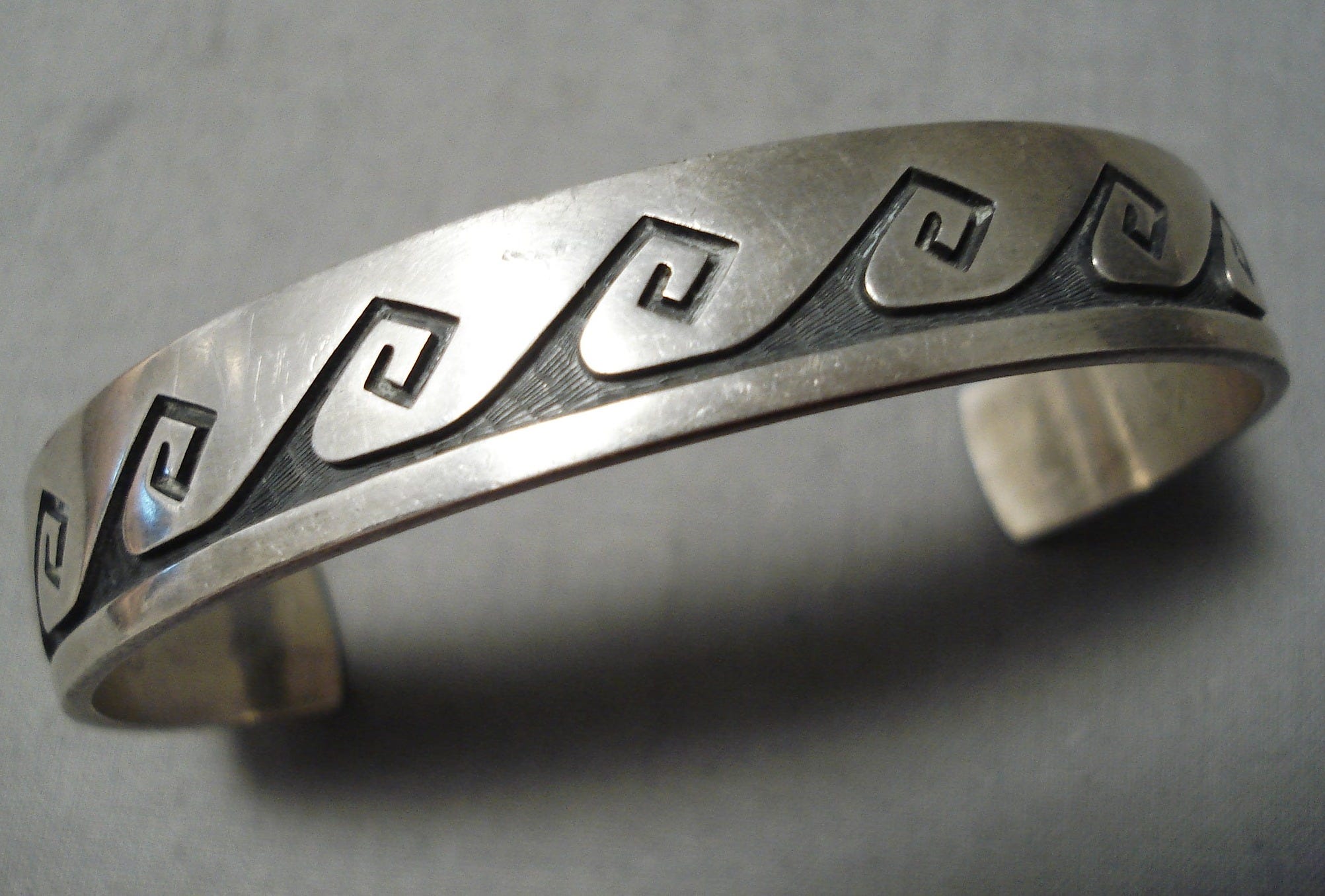
The Zunis use the overlay technique to produce their jewelry and inlay stones instead of oxidizing their designs.
Hopis have beautiful customs and beliefs. Like all tribes, their culture is recorded by artists. There has been no photography since the Smithsonian commissioned John Wesley Powell in 1899 to record and create an accounting of all North American tribes for the Bureau of American Ethnology.
The Hopi emergence occurred from the earth via the San Franciso Peak at Flagstaff, Arizona. The peak is nearly 100 miles south of the Hopi Mesa, but majestically visible from Hopi country. The original emergence occurred when kachinas arose from the extinct volcano, which provides a pathway into the earth. Throughout their history, the kachinas have emerged from the peak in early February and joined the people for six months before returning back into the earth in July. There are about 300 different kachinas in the Hopi culture. Each kachina has a specific representation and function. A kachina is the same for a spiritual image, a physical image, a carving, and a painting. It is a primarily means of cultural perpetuation.
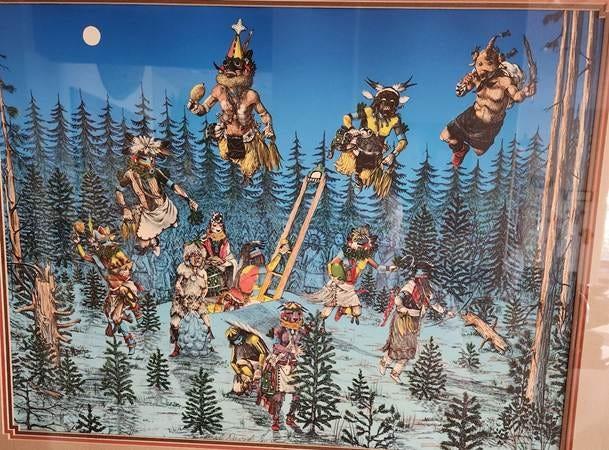
Emergence of Hopi kachinas. The ladder is an important part of Hopi kivas.
Lithograph by Neal David
The kachina trek from the earth to the village mesas includes a procession lead by Eototo, the “chief” kachina and his “lieutenant”, Ahuli.
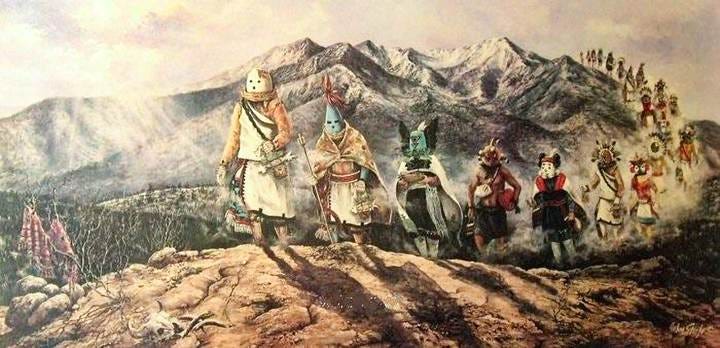
Kachina procession from San Francisco peak to the mesas.
Painting by John Steele
When the kachina procession arrives at a village, Eototo and Ahuli bless the ground with water and seeds. The Powamu Ceremony, known as the Bean Dance, begins. In preparation for the event, bean sprouts are grown in the kivas. The heat in the kivas is very high so that the sprouts grow within three days. During the year, bows and arrows are made for boys and kachina dolls for girls. Everything is distributed among the people during the event, which lasts several days.
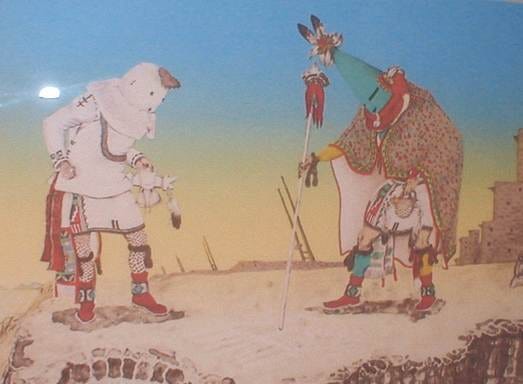
Eototo and Ahuli blessing the village ground
Lithograph by Neil David
Periodically during the event, Salimobia kachinas appear. They carry yucca whips and function as “enforcers”. Their appearance signifies that all people must enter a home and not look out at the kachinas doings. If anyone violates the doings, the Salimobias will beat them with yucca whips until they are rescued. The rescuer(s) will come out of a home protected with thick padding on their backs and take the beating while the perpetrators retreat to a home. Should they retreat to a car, the windows will be beat out with rocks.
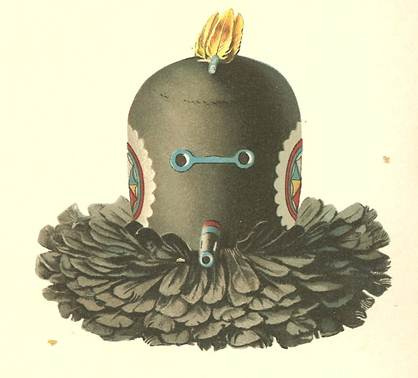
Salimobia Kachina Mask
Photo from American Bureau of Enthology
It is acceptable and appropriate practice for non-Hopis to take food, fruit, candy, nuts, etc. as a token of appreciation for hosting in Hopi homes.
When silence, no dance bells, is attained outside the homes, people emerge to again view ceremonial activities. Once the ceremonies conclude the kachinas will retreat to their kiva where they will reside for the next six months. The kachinas are portrayed by men. Women are allowed in a kiva at select times. When a man enters a kiva, he is no longer considered as a human; rather, the kachina to which he has been assigned. It involves conversion of conscientiousness. Non-Hopis refer to it as channeling.
In my book, Coyote: The Life and Times of Navajo Artist David Chethlahe Paladin I tell how David received kiva training at San Felipe Pueblo while he was a teenager at Santa Fe Indian School. It was unique in that Navajo do not share the same beliefs as the Pueblos. It was his kiva training that prepared him to alter his conscientiousness while enduring German concentration camp torture.
David Reynolds from Hamilton Stores in Yellowstone was with me one day when we happened upon Sokoya and the Ogres kachinsa making their rounds on the first mesa at Walpi. The Ogre, among other things, are threats to misbehaving children – the boogie man. They are ominous looking kachinas with grotesque eyes and long beaks. They carry bloody saws and knives and omit moaning sounds.
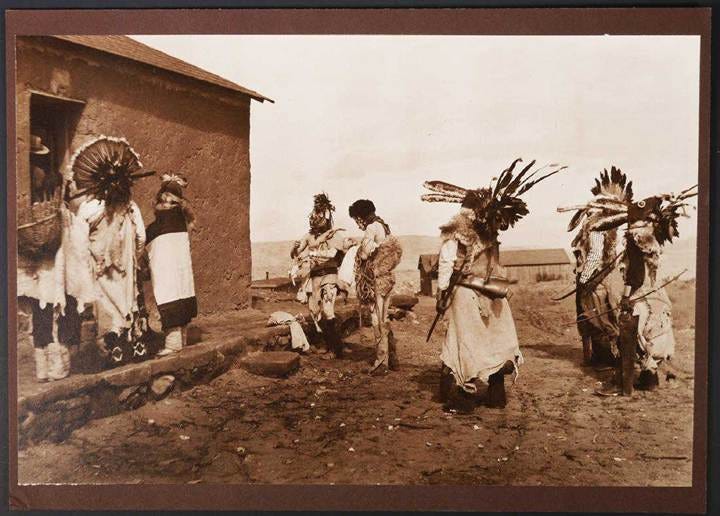
Ogre entourage in search of misbehaving children.
The Sokoya accompanies the Ogres carrying a basket into which an Ogre will place a child to be carried away for punishment or eating.
Photo from American Bureau of Enthology
When the entourage approaches a home, their moans are accompanied by scraping bloody saws and axes against the home. They strike fear in the home and an ensuing event takes place as the mother and Orgres engage in a sing-song ritual with the Orgre demanding a child for punishment and the mother pleading against it. Eventually, the entourage proceeds to another home and a misbehaving child likely learned a lesson.
David was appreciative of observing the event that I had been relating to him not much earlier. It is an interesting practice in child psychology that has endured for centuries (without harassment charges!)
After six months among the Hopi people, the kachinas gather for the Home Dance announce and prepare for returning to the San Franciso Peak and the bowels of the earth for the next six months. The Home Dance is usually fewer kachinas and often of the same type, I have seen a Home Dance Ceremony with about fifty of the same kachinas.
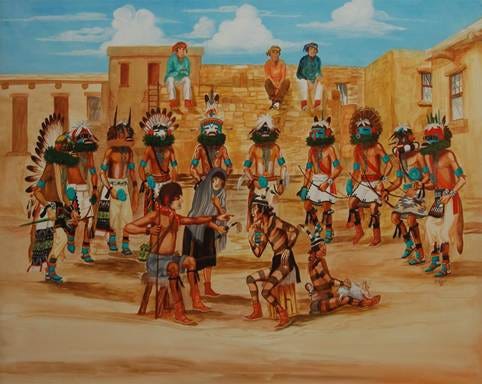
Home Dance
Painting by Ray Naja (son of Daisy Nampeyo Hooee)
While the kachinas are in the earth, the kivas still maintain contact though visceral telepathic communication. The highlight of the kachina absence among the people is the Snake Dance Ceremony.
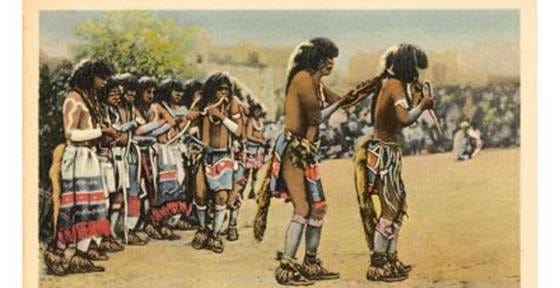
Photo from American Bureau of Enthology
Several months before the August ceremony, men and boys gather snakes from throughout their village region. The snakes are both poisonous and non-poisonous and kept in the kivas until time for the ceremony. The Snake Dance participants are not considered as kachinas. There are messengers from the Hopi people to the earth-bound kachinas. A participant is accompanied by an attendant. The snake dancer carries a snake, often times in his mouth. The attending dancer carries a large eagle feather to detract the snake from biting the snake dancer. Other dancers keep snakes loosely confined in the plaza using the feathers to maintain order. Dancers parade through the dance plaza with regular turns over a “thunder” board upon which they stamp their feet. The sound is a signal to the kachinas that the Hopi people have messages for them. At that time, the pair release their snake and receive another snake. Attending dancers with feathers try to maintain order with snakes on the ground which often wander into crowds of people. At the conclusion of the ceremony the dancers gather the snakes and run from the village carrying them for release. Once released, the snakes will enter the earth and deliver messages to the kachinas.
In the early 80s, I took my family (Sheila, Cass, Megan, JD, and Christopher) to see a Snake Dance. Shungopavi is about 175 miles from Gallup so we left early so that we could get a good rooftop seat overlooking the dance plaza. We arrived about 11am and settled in, knowing that the ceremony wouldn’t start until about 4pm. During that time, it rained several times. My daughters were reasonably certain that they would be seen with wet hair or worse, stringy after being sundried. As the ceremony neared its start, the Hopi people came out and took our seats, which was fine. It is their ceremony. But when we moved back, we still had good seats since we had a good starting point.
Several Hopi craftsmen were favorites of mine. Victor, of course, had an association with us since the 50s. Fred Kabotie was an accomplished artist having gained international recognition in Italy in 1932 and designed the murals in a lodge at Grand Canyon in the 30s. With his cousin, Paul Saufkie, Fred pioneered the overlay technique associated with Hopi jewelry that led to the creation of the Hopi Silvercraft Cooperative Guild in the 40s. He was also a kachina carver and an artist. When I founded the Indian Arts & Crafts Association in 1974, I asked Fred to serve as a director, which he did. We always got a good laugh with Fred’s continuous motions for board meetings in Hawaii.
The most talented Hopi silversmith I ever encountered was Bernard Dawahoya. He methodically made outstanding jewelry. His wife, Alice, took care of financial matters. In the 80s, he opened his own shop at Shungopavi.
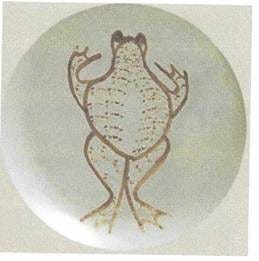
My favorite American Indian potter was Joy “Frogwoman” Navassie in the Keams Canyon area. Whenever I was flying nearby, I would buzz her home. If she waved a dish towel, that meant that she had some pottery so I would land at the Hopi airstrip, eleven miles away and await her and her husband, Perry. Often times one of her daughters would come with pots as well. They could make their pots, but Joy painted them and put each daughter’s initial next to her signature frog on the bottom.
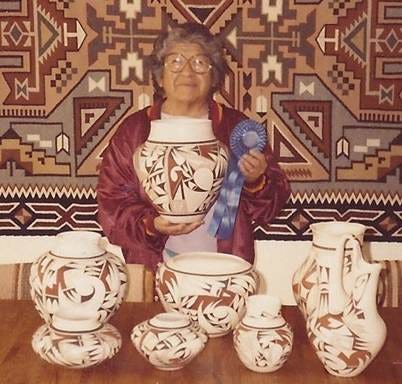
Picture taken in my kitchen at Gallup.
I did a lot of business with the McGee brothers, Bruce and Ron, at Keams Canyon Trading. They always had great Hopi crafts. Their brother, Ferron, was at Piñon Mercantile at Piñon. Piñon Merc was known for large Navajo rugs. Both are family operations, and they were great to deal with. Piñon Merc was destroyed by fire in the 80s.
The Hopis are wonderful and hospitable people. I have always enjoyed my time with them on their reservation. Kachinas are one of my favorite American Indian crafts because of their authenticity, beauty, and cultural significance. A great deal of their culture has been recorded by Hopi artists.
What They Said newsletter goes out once per week. Substack provides me, as a writer, an alternative means of publication to supplement six books that I have written; four about southwestern culture that include American Indian trading of which I am a 3rd generation trader, a major tribal ceremony, and a prominent Navao artist biography. What They Said is a collection of quotations that I have accumulated for 65+ years. Thus far I have prepared and scheduled weekly posting through June 2025 and still regularly write. If you wish to become a paid subscriber, there is a choice of rates: $6 per month or $60 per year to support this project. Thanks.
Next week: Interesting times with Navajo basketball